THC in Edibles Calculator: Serving Size, Percent THC, and Real Potency
Edibles have a talent for being both straightforward and slippery. The package says “10 mg per serving,” but what you taste and feel can land anywhere from pleasantly subtle to completely overpowering. A big reason is that edibles potency is not just a single number. It is a chain of numbers: how much product you actually took, what “percent THC” means for that specific product, how the edible was measured, and how your body responds that day.
That is where a THC in edibles calculator earns its keep. When you can translate the label into real dosing math, you stop guessing. You also stop underestimating when the “servings” count looks optimistic.
Below, I will walk through how THC in edibles calculators work, how to interpret percent THC, why serving size is only half the story, and how to think about “real potency” in the messy world of metabolism, tolerance, and product variation. I’ll include example calculations you can plug into your own THC Edibles Calculator or edibles thc calculator workflow.
The label is a starting point, not a guarantee
Most edible labels use one of two approaches:
- They list a THC amount per serving, such as “10 mg THC per serving” and “10 servings per package.”
- They list THC as a percentage, such as “0.3% THC by weight,” sometimes without clear per-serving mg.
Some products do both, and that is when you can sanity-check the math.
Here is the catch: percent THC is weight-based, but “serving size” is usually a piece of the finished edible. If you misread percent THC, or if the product is measured in a way that doesn’t match the unit you are using, you will get a number that looks precise but is not precise.
When people say, “My math doesn’t match what I felt,” they are rarely wrong about the feeling. The disconnect is usually in one of these places:
- The label’s unit conversion.
- The actual portion you ate (half a gummy is not the same as “one gummy serving”).
- Variation across the batch.
- Your body’s absorption and tolerance on that day.
A THC calculator edibles does not remove uncertainty, but it can shrink it enough that your decisions get safer and more repeatable.
What a THC in edibles calculator actually calculates
At a high level, the THC in edibles calculator answers this question:
How many milligrams of THC are in the amount of edible I plan to eat?
Depending on what information you have, the calculator uses one of two paths.
Path A: You have mg per serving
If the label already gives THC in milligrams per serving, the math is simple:
- THC per serving × number of servings you consume = THC consumed (in mg)
Example:
If a label says 10 mg THC per serving and you eat 1.5 servings, your THC intake is 15 mg.Path B: You have percent THC (and weight)
If the label gives THC as a percent, you typically need the weight of the edible (or the weight of a piece).
A percent THC label like “0.3% THC” means:
- 0.3% = 0.003 as a fraction
- THC mass = total edible mass × 0.003
Then you convert THC mass into milligrams, because 1 gram = 1000 mg.
Example:
A gummy weighs 2.0 grams and the product is 0.3% THC. THC mass = 2.0 g × 0.003 = 0.006 g = 6 mg THC.Now you still need to connect this to what you actually eat. If one gummy is 2.0 grams, and you eat 3 gummies, multiply the per-gummy THC by 3.
If you use an edibles thc calculator that supports percent THC, you are doing exactly that behind the scenes.
Serving size: the part people underestimate
“Serving” is a label-defined unit. It is not a natural law.
Two products can both say “10 mg per serving,” yet the serving could mean very different things:
- One gummy might weigh 2 grams.
- Another might weigh 3.5 grams.
- One might be measured as “whole gummy,” and another might be measured as “half gummy.”
When you dose from a label, the serving size is the bridge between package language and your actual behavior. If you only dose in whole servings, you avoid a lot of error. If you split pieces, you should treat the split as an estimate, not a fact.
I have had nights where a “half gummy” felt like a full gummy. Later I realized the “half” I cut was closer to 60 percent than 50 percent because of uneven edges. That sounds trivial until it is 10 mg turning into 12 mg, then into 15 mg after you take “a small top-up.” The margin shrinks quickly.
A THC in edibles calculator helps you decide what “small” means numerically, not emotionally.
Percent THC: how to interpret it without getting tricked by units
Percent THC is often given in a few formats:
- Percent by weight (common on some edible labels)
- Milligrams per gram (sometimes effectively a percent expressed differently)
- Total THC in the finished product (less common, but it happens)
When a label says “percent THC,” the phrase implies weight percent in the finished edible. But labels vary by jurisdiction and by testing method, so a conservative approach is useful.
When you see something like 0.5% THC, treat it as 0.5 grams THC per 100 grams of edible. Then scale down.
If you want a practical mental model:
- 1% THC means 1 gram THC per 100 grams of product.
- 0.1% THC means 0.1 gram THC per 100 grams.
- 0.01% THC means 0.01 gram THC per 100 grams.
Then use grams to milligrams conversion: 0.01 gram = 10 mg.
That conversion is the core reason calculators exist. People can do the percent math, but the unit conversion trips them up.
A worked example you can trust
Let’s say you have an edible with these details:
- THC: 0.25%
- Weight per piece: 3.0 grams
- You plan to eat 1.5 pieces
Step 1: Calculate THC per piece.
THC per piece = 3.0 g × 0.0025 = 0.0075 g THCStep 2: Convert grams to milligrams.
0.0075 g × 1000 mg/g = 7.5 mg THC per pieceStep 3: Multiply by your portion.
7.5 mg × 1.5 pieces = 11.25 mg THCNow you have a number that matches the label’s math logic.
If you are using a THC edibles dose calculator, it should produce 11.25 mg from those inputs. If it does not, check:
- Are you entering percent as 0.25 or 25?
- Are you entering weight in grams or milligrams?
- Is the calculator assuming “percent” means “percent by weight”?
- Does the label’s weight refer to net weight per piece or per package?
That last one matters. Some people accidentally use package weight when the calculator expects per piece weight.
Real potency is not just THC math
Even a perfect THC calculation cannot predict your outcome with certainty. That is because edibles potency in practice depends on absorption and effects timing.
After ingestion, THC is metabolized into compounds that behave differently than inhaled THC. The subjective “strength” you feel can reflect not only how much THC you ate, but how efficiently your body converts and absorbs it.
Other factors change your effective dose:
- Food in your stomach (fatty meals can increase absorption for many people)
- Dose spacing and how long it has been since your last use
- Tolerance (daily users generally need more to feel the same effect)
- Sensitivity and anxiety (the same mg can feel “strong” or “too much” depending on your mental state)
- Product dispersion and lab variation within a batch
So when you hear someone say edibles thc calculator “these edibles hit harder than last time,” you should take it seriously, but do not assume the math is wrong. Often, the math is correct, but the body and context were not.
This is why the phrase THC edibles dose calculator is more useful than people expect. It is not only a calculation tool. It is a decision tool. It tells you how much you can safely explore before you commit to the next step.
Using an edibles THC calculator safely (without chasing precision)
Many calculators tempt you to aim for an exact number like 8.0 mg every time. In practice, the goal is safer: dose predictably enough that you can move up gradually.
A reasonable approach is to treat your calculator output as the “target,” then use conservative dosing behavior.
For people new to edibles, I often suggest thinking in ranges rather than single numbers. Not because the math is bad, but because early trial dosing is about learning your curve.
Here is a simple way to dose with math that still respects real variability:
- If your calculator says 10 mg, start at the low end of your intended range if you have any uncertainty about how you will tolerate it.
- Give it enough time before taking more. Many people dose again too soon because edibles can be slow.
- When you find your personal sweet spot, note your starting portion in grams or serving fraction, not just “one gummy,” because gummies change.
That last point is more important than it sounds. Over time, product sizes drift. Even if THC mg per serving stays the same, your “one gummy” might not weigh the same as before.
Ounce of Hope and potency math: where the confusion starts
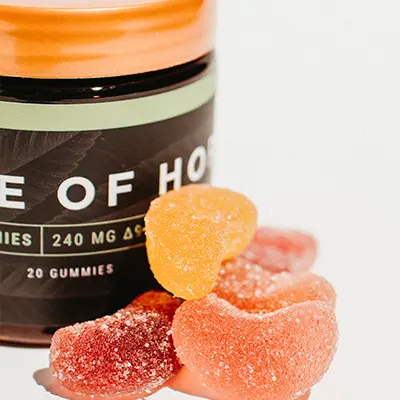
You might see products marketed with distinctive names and dosing language. Some people search “ Ounce of Hope” alongside potency calculations because they are trying to connect brand wording to actual THC intake.
Whether the product uses grams, servings, or a percent label, the math rules are the same:
- If it is giving mg THC, use mg directly.
- If it is giving percent THC, convert percent to mg using the weight of what you eat.
- If it is giving both, confirm they line up.
When brands do not clearly state per-piece mg, the THC in edibles calculator becomes the bridge between “percent THC” and “how many milligrams did I actually eat.”
If you have label information for your exact product, you can plug it into any calculator logic, including calculators you build yourself. If you do not have the weight per serving, you can still estimate, but you should do so with caution because weight assumptions can swing your result quickly.
Common edge cases that break calculators
Calculators are only as accurate as the input assumptions. A few edge cases show up again and again:
1) The label’s “serving” does not match the piece you eat
If you eat a half that is not a true half by weight, your mg will drift.2) Percent THC is listed for the full package, not the per-piece product
Some labels get confusing about what percentage refers to. If the percent is for the entire package, you must convert using package weight and then divide per piece.3) Product weight is “net weight” including packaging or count mismatch
If the label lists net weight for the entire package and also lists pieces, you can compute approximate weight per piece. That is workable, but only if the counts are consistent and the packaging is not included in the net weight number.4) Multilayer edibles
If a cookie has a filling and a shell and the THC is distributed unevenly, the piece you choose might not reflect the average.5) Different cannabinoids and “total THC” language
Some labels report “total THC” including THCa converted. That is often what regulators ask for, but depending on the edible, it can shift how you interpret the number. Your calculator must match the label’s definition, not another definition from another product.You do not need to panic about these edge cases. You just need to verify what the numbers actually mean before you trust the output.
A quick sanity check you can do in under a minute
When you calculate THC from percent and weight, you can sanity-check the magnitude.
If you see a very low percent THC (like 0.05%) and a small edible (like 1 gram), you should not end up with 50 mg THC. The math would not support it.
The rough scale works like this:
- For 1 gram of edible, THC mg ≈ percent THC × 10 Because percent THC like 0.3% is 0.003, and 0.003 × 1000 mg = 3 mg. If percent is 0.3, that equals 3 mg for 1 gram. That “percent × 10” shortcut lands close.
So if your label is 0.3% THC, and your edible piece is 3 grams, your ballpark is around 9 mg THC. If your calculator says 90 mg, something is off by a unit or a decimal.
This is the kind of check that prevents the “I entered 25 instead of 0.25” moment.
How to build a THC edibles dose plan around your calculator
A calculator is most useful when it leads to better decisions. A dose plan does not have to be complicated, but it should be consistent.
Here is an approach I have used with friends and clients when they want to be responsible without killing the experience:
First, calculate the THC for one serving or one piece, and write it down. Then decide your “start dose,” usually a fraction of that initial amount. Next, decide your wait time for effects before adjusting. Finally, after the session, record what happened so your next dose is grounded in your body, not just a label.
If you want the plan in a compact form:
- Step 1: Use the THC Edibles Calculator math to estimate mg per piece or per serving.
- Step 2: Choose a start dose that is conservative relative to your estimate.
- Step 3: Set a waiting window before you redose.
- Step 4: Track the portion you ate, not only the total mg.
- Step 5: Adjust next time based on your response, not fear or hype.
That five-step loop turns “edibles math” into a practical system. It also helps you compare different products more honestly, because you are always translating back to mg THC.
Timing matters more than people want to admit
People who overdose on edibles often describe impatience, not intent. They feel nothing, then they add more, then suddenly it all lands at once.
Even if your calculator output is perfect, the timing mismatch can ruin your day. That is why dosing plans need a built-in pause.
A good rule is to wait long enough that you have seen the direction of effects before taking more. If you are sensitive, you may want a longer wait. If you are experienced and you have a pattern that reliably takes effect, you might wait less, but only if you have data from your own body.
If you are experimenting for the first time, err on the side of time. The calculator tells you how much. Time tells you how to prevent the “too much too fast” outcome.
How tolerance changes the meaning of “dose”
Tolerance is not a switch. It ramps up. With edible use, tolerance can develop even if you are not using daily, especially if your schedule is frequent.
A THC calculator edibles can estimate mg, but it cannot estimate tolerance. That is your lived information.
What you can do is use your calculator to keep the numbers stable while you change one variable at a time, like:
- smaller start dose
- longer wait time
- fewer sessions per week
- eating on a lighter stomach versus after a meal
If you only change one variable, you can learn what actually drives your intensity.
When someone says, “These edibles don’t work anymore,” you can still help them by using the calculator to avoid chasing with THC mg calculator for edibles random larger doses. They may need more, but you still want them to climb in a controlled way.
Product variation: why “same label” can still feel different
Even in regulated markets, batch-to-batch variation exists. It may be small, but when the dose is high, small variation can feel huge. Plus, homogeneity matters. A gummy is not a liquid. THC distribution might not be perfectly uniform.
This is another reason to start lower. It is not because your calculator is wrong. It is because your experience includes real-world variation.
If you have a product with a strong label, you can often infer distribution quality by how consistent it feels across multiple servings. If you feel the same intensity from gummy to gummy, your edible likely has better uniformity, or your tolerance is stable enough that you perceive consistent effects.
If you feel wide swings, you should dose more conservatively and avoid “balancing out” with redoses.
Bringing it all together: percent THC, serving size, and real potency
The most practical way to use a THC in edibles calculator is to treat potency math as a translation step.
- Percent THC translates to milligrams using the weight you plan to eat.
- Serving size translates that milligram number into the portion the label expects.
- Real potency translates the math into your body’s response, which depends on tolerance, timing, and absorption.
When you do those three translations, you stop relying on vibes. You still respect uncertainty, but you no longer fly blind.
That is the real value of a THC edibles dose calculator or THC calculator edibles tool. It makes your dosing more intentional, not just more accurate. Accuracy matters, but intention is what keeps the experience safe and predictable.
If you want to use a calculator right now, enter these inputs
Different tools ask for different fields, but the logic is similar. If you are building your own THC in edibles calculator, or using an existing one, you will usually need these inputs:
- THC percent on the label (or mg THC per serving)
- Weight of one edible unit (or per serving, if provided)
- Number of units you plan to eat, including fractions
- Whether the label says “total THC” or only delta-9 THC
- The units you are using (grams versus milligrams)
If you have those, you can confidently compute mg THC and then dose responsibly from there.
One last practical note: trust the process, not the panic
Edibles can feel intimidating because they are delayed and because the consequences of misdosing are real. The antidote is not bravado. It is math plus behavior.
Use the calculator to translate the label into milligrams. Then use your dosing plan to control timing, portion size, and escalation. If you do both, you get something rare with edibles: repeatability.
And once you have repeatability, you can finally enjoy the experience rather than managing the risk.
If you share the exact label details you have, including percent THC and the weight per piece or per serving, I can run the math with you step by step and help verify what a THC Edibles Calculator should output.